Session Synopsis
“No use of PPT”
“No lecturing or gyaan because this audience is too seasoned for all of this”
“Make it interactive and engaging”
“It should be facilitative”
“Everyone must have at least 1-2 meaningful takeaways by the end of it”
“It has to be application based, not at a topical or superficial level”
“We would like you to use some case studies too”
“Everyone should know all the stages of design thinking by-heart, at the end of the session”
“We can only give you 1.5 hours for this.”
————————————————————
While all the other conditions seemed reasonable, the last one made me gulp twice.
(Told ya, the ask of this client was as unique as the client itself. )
Uhmm, what? Case-study and application-based design thinking workshop? 40 people? And 1.5 hours??
(I was almost convinced this was a joke)
Anyway, so here’s a flow of how I went about it, to optimise Design Thinking in a capsule module.
1) Left Hand Writing
Used this to swiftly and effectively set context. The “jolt” here acted as a hook to keep the participants glued and gripped, creating curiosity for the rest of the program
2) Textra
Grouped the participants and handed them pre-reads, which they were to then understand, lucidify and illustrate on a flip chart for peer sharing.
This is the stage where we spent the most time, allowing room for ample discussions. The participants were encouraged to correlate every stage of DT with their real work-life experiences and scenarios, and reflect on its corresponding application at work.
3) Group Presentation
This is where the magic happened. Each group came up with a different application of DT at work, and explained every stage and concept using various work-life metaphors and also came up with what they could do better here on.
3) FGD through Case Studies
Handouts of case studies were distributed in the groups, with structured and specific questions to ponder on and discuss.
This not only dissected the case study for the participants but also acted as a double edged sword for summarisation, leading the group towards closure.
4) Closure
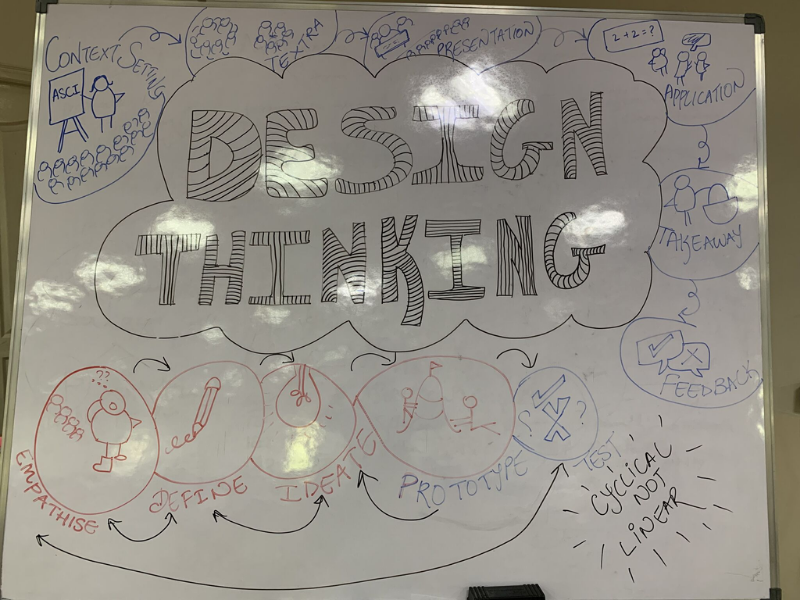
Participants were invited for a Gallery Walk to soak up the highlights and nuggets of the session that were scribed through visual recording; followed by collating their takeaways and feedback.
Fac Nuggets:
1) Frankly, I was contemplating whether or not to spend time in group presentations. We were running against time and I had to pick between running another process, or spend time cementing the ongoing process. So glad I chose the latter as it was a turning point for the cohort. With so many questions, inputs, insights and applications pouring in from 40 people, it made for a holistic learning experience.
2) Parallelly, as the workshop was progressing, I visually recorded the highlights and nuggets of the session to act as anchor, which proved beneficial.
No use of PPT, No Lecturing